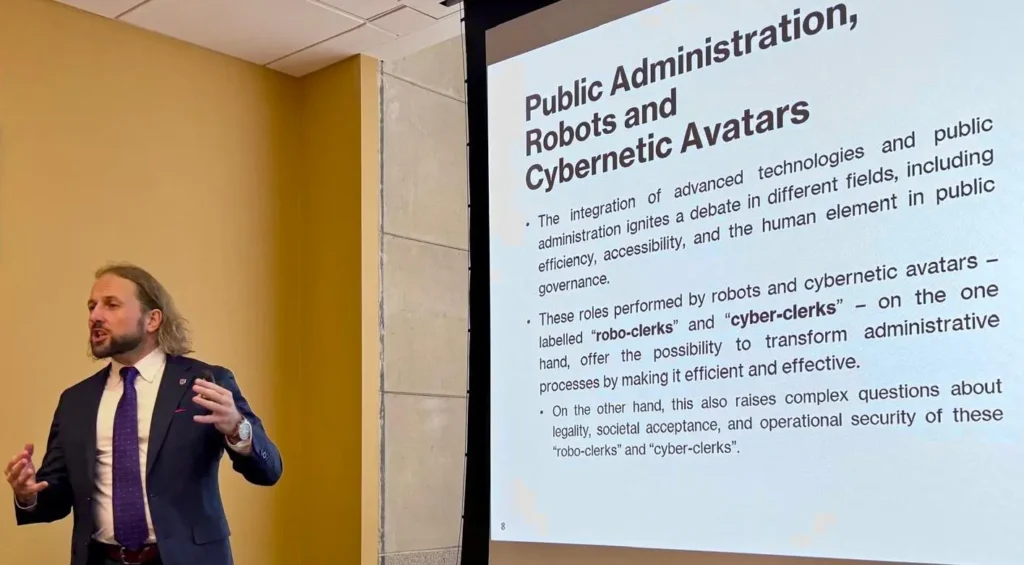
I delivered a lecture at the University of Pennsylvania Carey Law School titled: "Public Administration Bureaucrats versus Bureaunoids: The Role for Robots and Avatars in Public Administration".
I placed the idea of bureaunoids within the context of the smart city, which I see as the right environment for their growth. I offered definitions for both the "robo-clerk" (an autonomous robotic system capable of performing administrative tasks) and the "cyber-clerk" (denoting a cybernetic avatar, remotely operated, that mimics human interaction through digital interfaces). Both represent "AI-clerks", or "bureaunoids", which I defined as AI-driven systems, embodied in autonomous robots or remotely operated cybernetic avatars, designed to perform administrative tasks by processing data and interacting with stakeholders in bureaucratic processes.
I talked about opportunities and challenges of using bureaunoids in public administration. To address the issues, I propose a solution that could, for example, take the form of human-AI collaboration. This process would involve initial work done by bureaunoids and then evaluated by humans. This could resemble a reversed "Minority Report" - a "Humanity Report" - where human judgment, strengthened by suggestions from AI-driven robo- or cyber-clerks, would prevail. I compared this mechanism to the challenge system or Video Assistant Referee (VAR) verification used in sports.
On the other hand, we cannot exclude the possibility that, under certain circumstances, a well-calibrated decision made by a bureaunoid could be the better option. That is why procedures for using AI in public administration must be established. This is particularly important for issuing decisions with legal consequences.
If you are interested in this topic, please refer to my chapter.